


What Happens When Schools Skip Insurance Verification: The Transportation Risk Most Administrators Underestimate
Every school year, dozens of Queens athletic teams, debate clubs, and science classes face the same scenario: a hastily booked charter vehicle pulls up without proper commercial insurance documentation, the driver lacks 19A certification, or the vehicle holds twelve passengers when seventeen students are scheduled to board. By the time administrators discover these gaps, students are already loading equipment, parents have left the parking lot, and calling off the trip feels impossible. The real cost of these oversights extends far beyond inconvenience—inadequate insurance coverage can expose school districts to catastrophic liability if an accident occurs during transport, while uncertified drivers violate New York State education law regardless of whether anything goes wrong. For Queens schools managing car service near me bookings for field trips and athletic competitions, understanding how professional ground transportation actually works becomes the difference between safe, compliant travel and preventable disaster.
📋 In This Guide
Queens presents unique transportation challenges that compound these risks. With over 2.4 million residents spread across neighborhoods from Flushing to Jamaica, schools coordinate trips to destinations as varied as CUNY campuses in Manhattan, athletic fields in Nassau County, and museum programs in Brooklyn. Traffic congestion near JFK International Airport and LaGuardia Airport corridors creates unpredictable travel times, while parkway restrictions on certain vehicle types force route modifications that administrators may not anticipate. Middle-income families throughout Forest Hills and Astoria expect reliable, professional transportation that justifies both the cost and the trust they place in school trip organizers—yet many parent organizations and athletic directors learn compliance requirements only after problems surface.
New York State Legal Requirements for School Event Transportation: The Non-Negotiable Baseline
New York maintains stricter charter vehicle regulations than most states, and schools booking private transportation face distinct legal obligations that differ significantly from standard yellow bus contracts. Any driver transporting students must hold 19A certification from the New York State Department of Motor Vehicles, with an Abstract of Driving Record showing Active-School-Qualified status. This certification involves fingerprinting, criminal background checks, and completion of safety training modules specifically designed for student transport—requirements that eliminate the vast majority of standard livery drivers from eligibility.
Insurance liability minimums for school transportation vendors include commercial general liability coverage of at least one million dollars per occurrence and automobile liability insurance with a combined single limit of five million dollars per occurrence. These thresholds far exceed typical commercial auto policies, and schools must verify that the Department of Education appears as the certificate holder on the ACORD 25 Certificate of Liability Insurance before any trip begins. The distinction matters: if a vehicle lacks proper coverage and an accident occurs, the school district becomes the primary target for legal claims rather than the transportation vendor.
Any vehicle utilized to transport students must comply with all federal, state, city, and Department of Education rules and regulations, including standards for vehicles and drivers. For car service providers, this means executive sedans, SUVs, and sprinter vans must undergo Department of Transportation inspection even when they don’t qualify as traditional school buses under Vehicle and Traffic Law Section 142. Schools cannot waive these requirements or accept verbal assurances from vendors—written documentation proving compliance must be collected and retained for every booking.
| Compliance Requirement | What Schools Must Verify | Consequence of Non-Compliance |
|---|---|---|
| Driver 19A Certification | Copy of DMV Abstract showing Active-School-Qualified status | Violation of Vehicle and Traffic Law Section 509; district liability exposure |
| Commercial General Liability | $1,000,000 minimum per occurrence; DOE as certificate holder | School district becomes primary defendant in injury claims |
| Automobile Liability | $5,000,000 combined single limit coverage | Insufficient coverage for catastrophic accidents; district financial exposure |
| Vehicle DOT Inspection | Current inspection sticker visible; maintenance records available | Equipment failure liability; regulatory violations |
| Worker’s Compensation | Coverage in amounts prescribed by New York law | District exposure for driver injuries during trip |
Matching Vehicle Capacity to Student Group Size and Equipment Requirements
One of the most common mistakes Queens schools make involves miscalculating actual passenger needs versus stated vehicle capacity. A luxury sedan rated for four passengers cannot accommodate four high school athletes plus equipment bags, debate team display boards, or musical instruments—yet administrators frequently book vehicles based solely on headcount without accounting for cargo volume. The result: students arrive at pickup locations to discover gear won’t fit, forcing last-minute scrambles for additional vehicles or leaving essential equipment behind.
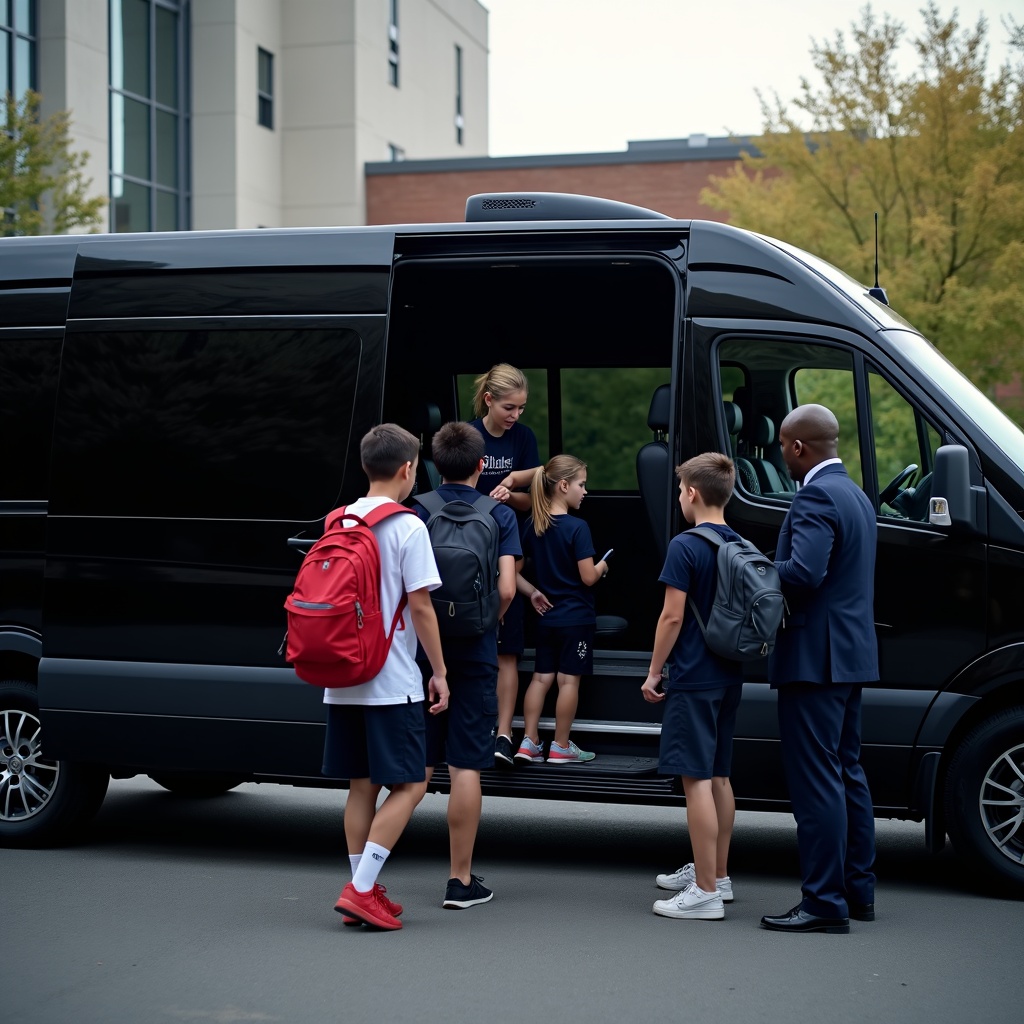
Professional car service offerings typically segment into four categories for school use. Executive sedans work well for individual student transport to specialized programs or medical appointments, accommodating three to four passengers with minimal luggage. Full-size SUVs like the Cadillac Escalade handle six to seven passengers with moderate equipment loads, making them suitable for small academic teams traveling to regional competitions. Mercedes Sprinter vans provide the sweet spot for many school trips, seating fourteen passengers with dedicated cargo space for athletic equipment, science fair projects, or band instruments. For larger groups exceeding fifteen students, charter buses become the appropriate choice rather than attempting to coordinate multiple car service vehicles.
The calculation extends beyond simple seat counts. In school vehicles not built to meet federal school bus construction standards such as cars, vans, suburbans and SUVs, New York State law requires all children to ride in properly installed, federally-certified child safety seats or boosters until their eighth birthday. This regulation catches many middle schools off guard when transporting sixth and seventh graders who may still fall under the age threshold. Schools must either provide appropriate safety seats for younger passengers or confirm that the car service vendor supplies compliant equipment—an often-overlooked detail that creates compliance gaps during elementary school field trips.
Equipment Load Planning for Athletic Events
Athletic trips present particularly complex space requirements that generic passenger counts obscure. A varsity soccer team traveling to an away game in Nassau County requires not just seats for eighteen players and three coaches, but cargo capacity for warm-up gear, water coolers, first aid supplies, and backup uniforms. Track and field equipment includes throwing implements, hurdles, and pole vault equipment that won’t fit in standard passenger compartments. Wrestling teams transport individual gear bags plus team mats that require dedicated cargo vehicles separate from passenger transport.
Smart schools booking car service in New York City and surrounding areas adopt a “passenger-plus-cargo” approach rather than trying to maximize seat occupancy. For a twelve-person debate team, this might mean booking a fourteen-passenger Sprinter operating at 85% passenger capacity to ensure adequate room for presentation materials and team resources. The incremental cost difference between cramming everyone into undersized vehicles and providing appropriate space typically amounts to 15-20% of the total transportation budget—a small premium for ensuring students arrive organized and prepared rather than disheveled and missing equipment.
Special Accommodations for Students with Disabilities
Trip organizers must determine whether participating students require nursing services, administration of medication, special transportation or other accommodations as set forth in an IEP, 504 Plan and/or DMAF/MAF. This requirement applies to all school trips regardless of destination or vehicle type, and schools cannot exclude students from field trips due to accommodation needs. For car service bookings, this often means ensuring wheelchair-accessible vehicles when needed, coordinating with vendors who can accommodate service animals, or arranging for vehicles with climate control systems that support students with temperature-sensitive medical conditions.
Vendor Vetting Process: Building a Pre-Qualified Transportation Provider List
Rather than searching for car service vendors trip-by-trip, successful Queens schools develop pre-qualified provider lists that undergo comprehensive vetting before any bookings occur. This front-loaded approach eliminates the rushed decision-making that leads to compliance failures and creates relationships with transportation companies who understand school-specific requirements. The vetting process should begin months before the school year starts, allowing adequate time for document collection, reference checks, and trial runs with lower-stakes local trips before committing to high-profile athletic championships or overnight excursions.
Schools should ask prospective bus companies if they comply with Article 19A and federal Department of Transportation regulations, require the company to provide names and recent driver license abstracts for a pool of drivers, and ensure drivers are school bus qualified with fingerprinting and criminal history clearance as required by Section 509 of Vehicle and Traffic Law. For car service vendors, this translates to requesting documentation for every driver who might be assigned to school trips, not just the company owner or primary contact. A reputable provider will maintain this information in organized files and provide copies without hesitation—vendors who resist documentation requests or claim their “system doesn’t track that information” should be immediately disqualified.
Schools should check with the New York State Department of Transportation regarding the bus company’s equipment and maintenance record. The DOT maintains public records of safety violations, inspection failures, and enforcement actions against transportation providers. A company with multiple recent violations indicates systemic problems rather than isolated incidents, regardless of how professionally they present during initial sales meetings. Schools can access these records through the Federal Motor Carrier Safety Administration’s Safety and Fitness Electronic Records system for interstate carriers or through NYSDOT for intrastate operators.
Reference Checks That Actually Reveal Problems
Generic reference requests produce generic positive responses that offer little useful information. Instead, schools should contact three to five comparable institutions—other Queens public schools, private schools in similar enrollment ranges, or youth sports organizations—and ask specific questions that reveal operational patterns. Useful inquiries include: “Has this vendor ever arrived more than fifteen minutes late for pickup?” “Have you ever received complaints from parents about driver behavior or vehicle condition?” “When last-minute changes occurred, how did the vendor handle communication and logistics?” These targeted questions force references to provide concrete examples rather than vague endorsements.
Schools should also verify that potential vendors carry appropriate insurance by contacting the insurance company directly rather than relying solely on certificates provided by the vendor. Insurance certificates can be outdated, and policies can lapse between issuance of a certificate and the actual trip date. A quick phone call to the insurer listed on the certificate confirms active coverage and verifies that policy limits match what the vendor has represented. This extra step takes five minutes but prevents the nightmare scenario of discovering inadequate coverage only after an incident occurs.
Establishing Booking Timelines and Oversight Authority for School Trips
Compressed booking timelines force schools into accepting vendors without adequate vetting and eliminate opportunities for careful planning around student needs. Athletic and field trip transportation qualifies as an ordinary contingent expense, meaning schools should build these costs into annual budgets rather than treating each trip as an ad hoc expenditure requiring special approval. Forward-looking athletic directors and academic department heads in Queens submit annual transportation calendars in May or June identifying all anticipated trips for the following school year, allowing business offices to negotiate favorable terms with pre-qualified vendors and establish predictable budget allocations.
Major events requiring specialized transportation—state championship games, overnight academic competitions, multi-school tournaments—warrant booking four to six months in advance. This timeline ensures access to the specific vehicle types needed rather than accepting whatever remains available in vendors’ fleets. It also creates buffer time for addressing complications: if the initially selected vendor becomes unavailable, schools have sufficient runway to engage alternates from their pre-qualified list without descending into crisis mode. For routine local trips such as transport to nearby colleges for dual enrollment classes or regular season athletic contests within Queens and neighboring boroughs, six to eight weeks advance notice typically suffices.
Schools should develop guidelines and protocols for the adult chaperone or school official assigned to the trip to follow before starting out and during the trip, with individuals authorized to take definite steps to ensure safe transportation of children including terminating the trip if equipment condition or driver fatigue pose significant threats to safety. This oversight authority must be explicitly delegated in writing before the trip begins—ambiguous responsibility structures lead to situations where problems are noticed but no one feels empowered to intervene. The designated trip supervisor should receive a checklist covering pre-departure vehicle inspection, driver credential verification, and criteria triggering trip cancellation or alternative transportation arrangements.
Managing Cancellation Policies and Weather-Related Changes
School event schedules fluctuate constantly due to weather postponements, facility availability changes, and opponent cancellations. Transportation contracts must address these realities through clear cancellation and modification terms rather than assuming trips will proceed as originally scheduled. Reasonable policies typically include full refunds for cancellations made more than seven days before scheduled departure, 50% refunds for cancellations 72 hours to seven days out, and no refund for cancellations within 72 hours unless weather-related. Weather cancellation clauses should specify which weather conditions trigger penalty-free cancellation—for instance, National Weather Service winter storm warnings or school district emergency closings.
The contract should also address vehicle substitutions and driver changes. If a vendor commits to providing a specific vehicle type (fourteen-passenger Sprinter van) and substitutes a different configuration without advance notice, schools should have contractual authority to reject the substitution and demand the originally specified vehicle or receive a pro-rated refund. Similarly, if driver assignments change within 24 hours of departure, schools should receive advance notification including the substitute driver’s name and certification credentials for verification before students board.
Parent Communication Protocols and Permission Documentation
Transportation arrangements that make perfect sense to administrators often confuse parents unless schools provide clear, detailed communication covering logistics, expectations, and emergency procedures. Standard permission slips rarely address transportation-specific concerns that parents actually worry about: Who is the driver? What happens if the vehicle breaks down? How will parents be notified if return times change? Will students be supervised during rest stops? Comprehensive trip information packets answer these questions proactively rather than forcing parents to email or call for basic details.
Effective parent communication materials include vehicle descriptions (“luxury SUV” means nothing to most parents, but “seven-passenger Cadillac Escalade with individual leather seats and climate control” creates clear expectations), driver credential summaries (“All drivers maintain 19A school transportation certification and complete annual background checks”), and detailed pickup/return logistics with specific street addresses and parking instructions for Queens locations where traffic patterns and parking restrictions create confusion. For schools serving diverse communities in Jackson Heights and Flushing where English may not be families’ primary language, translation of trip communications into the most common languages spoken by student families demonstrates respect and ensures all parents understand safety protocols.
The trip organizer must provide all parents with the parent consent form, and schools must use the consent forms attached to Chancellor’s Regulation A-670. These standardized forms cover essential liability waivers, emergency contact information, and medical authorization, but schools should supplement them with transportation-specific addendums addressing: student behavior expectations during transport, prohibited items (certain athletic equipment may need to travel in cargo compartments separate from passengers), electronic device policies during travel, and protocols for students who arrive late to departure locations or miss return pickups.
Real-Time Communication Systems During Travel
Parents expect—and deserve—updates when trips run behind schedule or routes change due to traffic or weather. Schools should establish clear communication chains before departure identifying who holds responsibility for parent updates and through which channels information flows. Some Queens schools use text message broadcast systems allowing trip supervisors to send location updates and revised return times to all trip families simultaneously. Others designate a school office contact person who receives updates from the trip supervisor and then communicates with families, creating a single point of contact rather than having the trip supervisor field individual parent calls while managing students.
For professional car service providers like M&V Limousines Ltd., GPS vehicle tracking often enables real-time trip monitoring that schools can access through web portals or mobile apps. This technology allows athletic directors to see exactly where their team transport is located and receive automatic alerts if vehicles deviate from planned routes or encounter significant delays. When parents call asking “Where is the bus?”, staff can provide specific, accurate information rather than vague estimates—a capability that dramatically reduces anxiety during trips that run long due to traffic around LaGuardia Airport or construction delays on the Long Island Expressway.
Cost-Effective Booking Strategies That Don’t Compromise Safety
Budget constraints create constant pressure on Queens schools to minimize transportation costs, but the temptation to select the cheapest available vendor frequently backfires. Unrealistically low quotes often indicate corners being cut on insurance coverage, driver certification, or vehicle maintenance—precisely the areas where compromises create liability exposure and student safety risks. Schools should approach transportation as infrastructure investment rather than discretionary spending, recognizing that reliable, compliant transport enables the educational programming that justifies the expense.
That said, strategic booking practices can reduce costs significantly without sacrificing quality. Consolidating multiple trips with a single pre-qualified vendor throughout the school year typically unlocks volume discounts of 15-25% compared to one-off bookings. Schools can negotiate seasonal contracts covering all fall athletic team transport or spring field trip needs at set per-mile or per-trip rates, eliminating the administrative burden of obtaining quotes for every individual trip while locking in favorable terms. Multi-school partnerships work particularly well for specialized transportation needs—when three Queens schools each need transport to the same regional science fair, coordinating departure times and sharing vehicle capacity can cut per-school costs in half.
Flexible scheduling also creates savings opportunities. Transportation demand peaks on Friday afternoons and Saturday mornings when most competitive events occur, while mid-week afternoon availability remains higher and typically commands lower rates. Schools with discretion over trip timing can reduce costs by scheduling field trips on Tuesday or Wednesday when vendor capacity utilization runs lower. Similarly, accepting slightly longer travel times by avoiding peak traffic windows—departing at 2:00 PM instead of 3:30 PM to beat rush hour—can reduce quoted rates as vendors face less pressure managing multiple simultaneous bookings.
Understanding What Actually Drives Transportation Costs
Many administrators misunderstand transportation cost structures, leading to frustration with quotes that seem higher than expected. Distance represents only one component of trip pricing—vehicle size, trip duration, wait time at destinations, number of stops, and return deadhead miles all influence final costs. A roundtrip from Forest Hills to a college campus in Manhattan may cover only twenty miles total, but if the vehicle must wait on-site for four hours during a campus tour, the vendor essentially removes that vehicle from their available fleet for an entire business day. Smart schools account for these factors when planning trips, sometimes discovering that extending a destination visit from two hours to four hours adds minimal incremental cost since the vehicle and driver are already committed.
Toll costs and parking fees in New York City and surrounding areas can add substantial expense that generic quotes don’t always itemize clearly. Queens schools traveling to Manhattan should confirm whether vendor quotes include bridge and tunnel tolls (Midtown Tunnel, Queens-Midtown Tunnel, Triborough Bridge) or if these appear as pass-through charges on final invoices. For trips involving multiple stops or extended destination time, parking fees at garages or meters can accumulate quickly—clarifying responsibility for these costs during contract negotiation prevents billing disputes after trips conclude.
Connecting with Professional Car Service for Queens School Transportation Needs
Schools navigating the complexity of transportation vendor vetting, compliance verification, and logistics coordination often benefit from partnering with established providers who specialize in educational institution transport and understand New York State regulations thoroughly. M&V Limousines Ltd. maintains comprehensive insurance coverage meeting DOE requirements, employs exclusively 19A-certified drivers with current background checks, and operates a diverse fleet including executive sedans, SUVs, and Mercedes Sprinter vans suitable for various school group sizes. The company serves Queens schools throughout Flushing, Astoria, Forest Hills, and Jamaica with experience managing both routine academic field trips and high-stakes athletic championship transport.
Whether your school needs reliable transport for debate team competitions, athletic event shuttles to venues across Brooklyn and the Bronx, or specialized vehicles for academic programs requiring equipment transport, discussing specific requirements with experienced transportation professionals helps clarify options and establish realistic timelines. Contact M&V Limousines at (646) 757-9101 to review your school’s upcoming transportation needs, verify driver credentials and insurance documentation, and receive detailed quotes reflecting actual trip parameters rather than generic estimates. Professional school transportation providers understand that parents entrust their children to your care—and that this trust extends to every vendor you engage to support educational programming.